Author: admin

  • Vegetable Microgreens: A Home Growing Guide, Seed Selection, Safety, Troubleshooting, and a Continuous Harvest Plan

    Vegetable Microgreens: A Home Growing Guide, Seed Selection, Safety, Troubleshooting, and a Continuous Harvest Plan

    Gardensel Research Team
    Home Growing • Safety • Seed Selection
    Microgreens

    Quick Summary

    The 1-minute overview
    • Microgreens: Grown from seed, exposed to light, usually harvested in 7–14 days by cutting above the surface.
    • Jar sprouts (sprouts) are not the same thing; sprouts are generally more delicate and require stricter risk management.
    • Success depends on three things: seed quality + watering without pooling + airflow.
    • Best beginner varieties at home: radish, broccoli, red cabbage, arugula, mustard.
    • The biggest mistake: overseeding + too much water + poor ventilation.

    1) What are microgreens, and why did they become so popular?

    Definition • Reasons

    Microgreens are a fresh crop harvested by cutting above the surface after vegetable and herb seeds sprout and their early leaves become visible. In the kitchen, even “a pinch” can change both aroma and presentation.

    For growers, the appeal typically falls into three categories:

    • Fast cycles: You can harvest within a week or two.
    • Small footprint: A tray or rack system is enough.
    • High perceived value: Freshness and aroma create a premium feel.

    The ease comes from the right setup. There’s no magic trick—just a set of small rules applied consistently.

    2) Microgreens or sprouts? Clear differences

    Comparison

    Jar sprouts (sprouts)

    • Usually germinate in darkness + high humidity.
    • Often eaten as a whole: root + stem.
    • Because warm, humid conditions also favor microbes, they require more careful risk management.

    Microgreens

    • Seeds are spread on a surface, exposed to light, and grow more “plant-like.”
    • At harvest, the root is usually left behind; the top is cut.
    • Risk is not zero, but control is easier.

    Bottom line: For home beginners, microgreens are usually the better starting point than jar sprouts.

    3) Past–present–future: where is this going?

    Context • Trend

    • Past: Sprouting is an old idea. “Fast freshness with minimal inputs” has always been valuable.
    • Present: Microgreens have become a standard fresh ingredient in both home and professional kitchens.
    • Future: City life means limited space; fast fresh food is here to stay. What will separate good from bad is seeds + hygiene + standardization.

    4) The health angle: realistic expectations

    Expectation Management

    Microgreens are not a miracle, but when used well they add freshness + variety + aroma to the diet. For people who struggle to eat vegetables regularly, they can make it easier to build a “vegetables are normal” habit.

    🧠 A realistic frame

    The foundation of any “health” claim is food safety. Without hygiene and process control, even the best-intentioned growing can end badly.

    5) Food safety: risks, red flags, and who should be cautious

    Most critical section

    The germination environment (warm + humid) is also friendly to microbes. At home, the goal is not a “sterile lab,” but a clean, controlled, repeatable routine.

    ⚠️ Higher-risk groups (be cautious with raw sprouts)
    • Pregnant people
    • Older adults
    • Young children
    • People with weakened immune systems

    Note: This is not medical advice. For those in a risk group, a clinician’s guidance provides the right framework for raw sprout consumption.

    “Do not eat” red flags

    If any of the following are present, it’s not “pick around it and eat.” Do not consume; discard the batch.

    • Sour/rotten smell
    • Widespread fuzzy mold
    • Sticky/slimy texture
    • Pooling water in the tray + rapid spoilage

    Core safety rules for home growing

    • Use food-grade seeds.
    • Clean equipment thoroughly before each batch, then dry it.
    • Avoid pooling (no standing water).
    • Don’t overseed (restricted airflow increases mold).
    • If there’s bad smell or mold, don’t “try to save it.”

    6) Can you do it at home? A home standard and realistic expectations

    Practicality

    Yes, you can do it at home—but not with the “anything goes at home” romance. You manage the triangle of light + air + water. The first goal isn’t “perfect product,” but a repeatable routine.

    7) Seed selection: the best microgreens for home and why

    List • Rationale

    Seed selection is half the game. Random “garden seed” is not a great idea. For food you’ll eat raw, choose food-grade (microgreen/sprouting-grade) seeds.

    A) A forgiving core list for beginners

    • Radish: Germinates fast; strong aroma; helps you lock in the routine quickly.
    • Broccoli: Grows evenly; neutral flavor; ideal for building consistency.
    • Red/Green Cabbage: Hardy; reliable germination; red varieties look great on the plate.
    • Arugula: Bold flavor; perfect for salads and sandwiches; you “feel the difference” quickly.
    • Mustard: Powerful even in small amounts; the flavor engine in mixes.

    B) Filling, high-yield types (need a bit more space/water)

    • Pea shoots: Thick texture; high yield; cycles can be a bit longer.
    • Sunflower: Crunchy and nutty; widely loved; more sensitive to watering and crowding.

    C) Gourmet aromatics (enter with experience)

    • Basil / Cilantro / Dill: Strong aroma; germination can be more finicky.
    🧩 The best beginner strategy

    Don’t mix varieties in your first 2–3 runs. Start with one variety (radish or broccoli) to lock the standard in. Then add cabbage/arugula/mustard.

    8) Growing microgreens at home: a clean, repeatable method (full detail)

    Step-by-step standard

    8.1 Choose the growing area

    Good options: a bright windowsill, a small rack system, or a well-ventilated spot in the kitchen. The biggest enemy is a stagnant, overly humid corner.

    8.2 Set up the equipment: eliminate pooling

    Minimum setup: a top sowing tray and a bottom tray to catch water. Best case: drainage holes in the top tray. If water is still pooling on the surface 10–15 minutes after watering, your balance is off.

    8.3 Cleaning standard (before every batch)

    Wash trays with hot water and detergent, rinse well, and dry. Keep scissors and the spray bottle clean too. Storing damp equipment in a closed space is basically an invitation to mold.

    8.4 Lay the surface: mat or paper?

    Growing mat (recommended)

    • Fit the mat snugly into the tray.
    • Moisten evenly; let excess water drain.
    • Target: “a damp sponge,” not a “wet pool.”

    Paper towel

    • Use 2–3 layers.
    • Mist to moisten.
    • Avoid bubbles/creases (they cause uneven germination).

    8.5 Prepare the seeds (soaking is not always required)

    Many small seeds don’t need soaking. Larger seeds like peas and sunflower can be soaked briefly and carefully; incorrect soaking creates smell and mold. For beginners, “assuming soaking is mandatory” is one of the most common mistakes.

    8.6 Sowing: get density right (the most critical step)

    Spread seeds evenly—like salting food. Don’t pile them on top of each other. Too dense → airflow drops → mold rises → seedlings weaken.

    8.7 First 48–72 hours: blackout (optional, but very useful)

    Cover with an empty tray and add a light weight. Check 1–2 times a day: if drying, add a little moisture; if pooling, reduce water. If the smell turns bad, you likely have stagnant air or too much water.

    8.8 Move to light

    When shoots start pushing up, remove the cover. Move to a bright spot. If you’re using a windowsill, rotate the tray once a day to reduce leaning.

    8.9 Watering: “small but consistent”

    Best method: bottom watering

    • Add a small amount of water to the bottom tray.
    • Let the mat wick it up.
    • Drain any remaining water from the bottom tray.

    Top misting (works, but be careful)

    • Mist like fog.
    • Don’t drown with droplets.
    • Do not create pooling.

    8.10 Ventilation

    After moving to light, don’t keep the tray covered. Don’t use a closed cabinet or an enclosed area. If the environment is too humid, move to a drier spot.

    8.11 Harvest

    Typically 7–14 days. Cut 0.5–1 cm above the surface with scissors; leave the root behind. Don’t overwater right before harvest: harvesting wet shortens shelf life.

    9) Troubleshooting: symptom → cause → fix

    Diagnosis

    Symptom Likely Cause Quick Fix
    Mold (cotton-like), sometimes a sour smell Too much water + sowing too dense + lack of airflow If mold/smell is significant, don’t eat it. Next batch: sow thinner, bottom-water, and increase ventilation.
    Bad smell, no visible mold Pooling / mat staying airless Reduce water. Don’t leave water sitting in the bottom tray (add a little → wick → drain). Choose a drier/cooler spot.
    Yellow and tall (leggy) Not enough light or light was given too late Move to light earlier. Rotate daily. Increase light intensity if needed.
    Uneven germination Uneven sowing / bumpy surface / weak seeds Flatten the surface, sow evenly, switch to food-grade seeds.
    Sticky/slimy texture Spoilage (too much water + poor ventilation) Do not eat. Reduce watering, increase airflow, clean equipment more thoroughly.
    🧪 Mold or root hairs?

    Root hairs usually appear only around the root zone, symmetrical, and as short fine fuzz. Mold spreads across the surface, forms cottony patches, and is often accompanied by odor.

    10) After harvest: washing – drying – storage

    Shelf life

    This is where home growers decide whether it’s “I grew it” or “I threw it away in two days”: moisture management.

    Do you have to wash?

    At home, many people do. The critical condition is: if you wash, you must dry well. Storing wet microgreens kills shelf life fast.

    A simple storage standard

    • Place a paper towel at the bottom of the container.
    • Add the greens.
    • Add another paper towel layer on top.
    • Refrigerate; if you see condensation, the greens are being stored too wet.

    11) Who can do it, and who should?

    Fit

    Ideal for home consumption

    • People who regularly eat salads/sandwiches/eggs
    • Anyone who wants fresh food in a small space
    • Families who want a “7-day plant” observation with kids

    For hobbyists considering small-scale production

    • Those who can maintain hygiene and routine discipline
    • Those who accept that “fresh” sales are mandatory
    • Those who can plan packaging and fast delivery

    12) Using microgreens in the kitchen: not “decoration,” function

    Practical use

    Used in the right place, microgreens can change the character of a dish. In most cases, adding them at serving time gives the best result.

    • Omelet/eggs: Add at serving.
    • Soup: Sprinkle on top at serving time.
    • Sandwich: Radish–arugula–mustard work extremely well in small amounts.
    • Salad: Add as an aroma layer on top of a regular salad.

    13) A 7-day starter plan (a “guaranteed route” for your first batch)

    Action

    Target variety: Radish or Broccoli (single variety) • Surface: Mat • Watering: Bottom, light

    • Day 1 — Setup + sowing: Wash and dry trays. Place the mat, moisten evenly. Spread seeds evenly. Cover + add light weight.
    • Day 2 — Check: If drying, add a little moisture. If pooling, reduce water.
    • Day 3 — Move to light: Remove cover. Move to a bright spot. Rotate tray.
    • Day 4 — Watering standard: Bottom-water lightly, let it wick, don’t leave water in the bottom tray.
    • Day 5 — Ventilation: Check odor. If growth is very leggy, increase light.
    • Day 6 — Approaching harvest: If too wet, reduce watering.
    • Day 7 — Harvest window: Cut with scissors, dry, store. Take notes: sowing density/watering/light.

    14) A “batch production” system for continuous harvest

    Sustainable routine

    The best way to stay consistent at home is not sowing everything on the same day. With batch production, you keep freshness continuous.

    Start with 2 trays

    • Tray A: Sow on Monday
    • Tray B: Sow on Thursday

    When you scale to 4 trays

    • Radish
    • Broccoli
    • Red cabbage
    • Arugula/mustard (light sowing)

    15) Frequently asked questions (FAQ)

    Quick answers

    Mold or root hairs?

    Root hairs usually appear only around the root zone, symmetrical, and as short fine fuzz. Mold spreads across the surface, forms cottony patches, and is often accompanied by odor.

    Is soil required?

    No. A mat-based setup is cleaner and easier to control.

    How many times a day should I water?

    Don’t water by the clock—decide by the surface: target moisture with no pooling. In most home setups, 1–2 checks per day are enough.

    16) Conclusion: easy, but not without discipline

    Summary

    Microgreens can be grown at home; they deliver fast results and add real value in the kitchen. But success isn’t a “secret recipe”—it’s an operating standard:

    • High-quality seeds
    • Watering without pooling
    • Air circulation
    • Clean equipment
    • Correct harvest + proper drying

    ↑ Back to top

  • Proper Use of Spraying Machines (Sprayers)

    Proper Use of Spraying Machines (Sprayers)

    Short summary

    Success in plant protection spraying with a sprayer depends on correct machine settings, choosing the right nozzle, maintaining the right driving speed, and performing regular calibration. Incorrect application reduces efficacy and increases drift-related environmental contamination, residue risk, and operator exposure. When maintenance and cleaning are neglected, nozzle clogging, uneven distribution, and equipment failures become inevitable.
    Update Note (2026): This content has been technically verified and updated from the older text.

    Basic definitions and concepts

    Sprayer: A machine that applies pressurized liquid to the target as droplets through nozzles (e.g., field boom sprayer, orchard air-blast/turbo/atomizer sprayer, backpack sprayer).
    Nozzle: The spraying component that determines droplet size, spray pattern, and flow rate.
    Flow rate (Q): The volume of liquid discharged by one nozzle per unit time (L/min).
    Application rate (spray volume): The amount of water applied per unit area (L/ha, L/da).
    Droplet spectrum: The distribution of fine–medium–coarse droplets. Fine droplets improve coverage but increase drift risk; coarse droplets reduce drift but may reduce coverage.
    Drift: The movement of droplets off-target due to wind.
    Calibration: Measurement and adjustment procedures to ensure the sprayer applies the intended rate with uniform distribution.

    Purpose and scope

    Purpose: To increase efficacy by applying in accordance with the label-recommended rate and technique, while reducing off-target contamination, residue risk, and environmental risk.
    Scope: Field crops (boom sprayers), orchards/vineyards/gardens (air-blast/turbo/atomizers), greenhouses and small areas (backpack/handheld sprayers).

    Operating principle / mechanism

    The pump pressurizes the mixture in the tank; the pressure regulator stabilizes pressure; filters retain solid particles; agitation keeps the product homogeneous; and the nozzles produce the spray pattern and droplet size. Application quality is determined by three main parameters:

    • Flow rate (Q): Varies with nozzle wear and pressure.
    • Speed (V): As speed increases, the liquid applied per unit area decreases.
    • Working width / nozzle spacing (W): Boom height and nozzle spacing determine overlap.

    Design and calculation logic

    1) Basic formula for a field boom sprayer

    Application rate per unit area:

    Rate (L/ha) = (600 × Q) / (W × V)

    Where:

    • Q = flow rate of one nozzle (L/min)
    • W = nozzle spacing (m)
    • V = travel speed (km/h)

    Note: All nozzles on the boom should be the same type and nominal flow rate. Mixing nozzles disrupts distribution.

    2) Example calculation

    • Nozzle spacing W = 0.50 m
    • Travel speed V = 6 km/h
    • Nozzle flow Q = 0.8 L/min (single nozzle)

    Rate = (600 × 0.8) / (0.5 × 6) = 480 / 3 = 160 L/ha

    With these settings, 160 L/ha is applied to the target. If the label-required rate differs, adjust nozzle flow (nozzle selection), pressure, or speed accordingly.
    The pesticide amount is determined by the label; “dose per decare/hectare” values must follow the product label and official recommendations; for prescription-only products, guidance from an authorized agricultural engineer is essential.

    Selecting the right nozzle (practical decision logic)

    Nozzle selection should be evaluated together with the target (leaf/weed/soil), application type (contact/systemic), drift risk, and the intended application rate.

    General suitability of nozzle types (summary)

    Nozzle type Droplet tendency Drift risk Typical use note
    Standard flat fan Medium–fine Medium Field surface applications; good coverage, caution in wind
    Drift-reducing / air-induction Coarse Low Drift-sensitive areas; often preferred for systemic applications
    Full cone Medium Medium Some fungicide/insecticide applications where volume and penetration are needed
    Hollow cone Fine High Orchards/atomizers and applications needing intensive coverage; requires calm conditions

    Critical rule: Do not use different nozzle types/combinations on the same boom (distribution and droplet spectrum become inconsistent).

    Application steps (field-practical)

    A) Before spraying

    Check the manual and the label

    • Review the sprayer manual, filter–nozzle diagram, and recommended pressure ranges.
    • Check the plant protection product label: target pest, timing, rate, mix compatibility, buffer zones, and PPE (personal protective equipment) requirements.

    Clean water and filtration

    • Fill with clean water. Dirty water is the fastest route to clogged nozzles/filters and uneven distribution.
    • Check the triple filtration setup: tank strainer + line filter + nozzle filter.

    Leak-tightness and mechanical checks

    • Inspect hoses, clamps, and fittings for leaks and cracks.
    • The pressure gauge and regulator must be functional.

    Nozzle and strainer checks

    • Remove and visually inspect nozzles; replace if worn, cracked, or deformed.
    • Clear blockages with compressed air or a soft brush. Using wire/nails enlarges the orifice, increases flow, and disrupts the droplet spectrum.
    • Never blow through a nozzle with your mouth (exposure risk).

    Agitation (mixing) check

    • If agitation fails, the mixture won’t stay homogeneous and “dose fluctuation” occurs within the same tank.

    Tank level indicator and capacity

    • Know the true tank volume and the accuracy of the level indicator. Level errors become dose errors.

    Calibration pre-check

    • Measure each nozzle’s flow at the selected nozzle and pressure (collect for 1 minute).
    • If nozzle-to-nozzle variation exceeds 10%, replace the relevant nozzle set.

    B) During spraying

    Manage weather conditions

    • Wind increases drift. Drift can also occur in very calm evening/night conditions with temperature inversion (e.g., foggy or smoky air that “hangs” near the ground).
    • In hot, dry, windy conditions, fine droplets are especially risky; choose drift-reducing nozzles and coarser droplets.

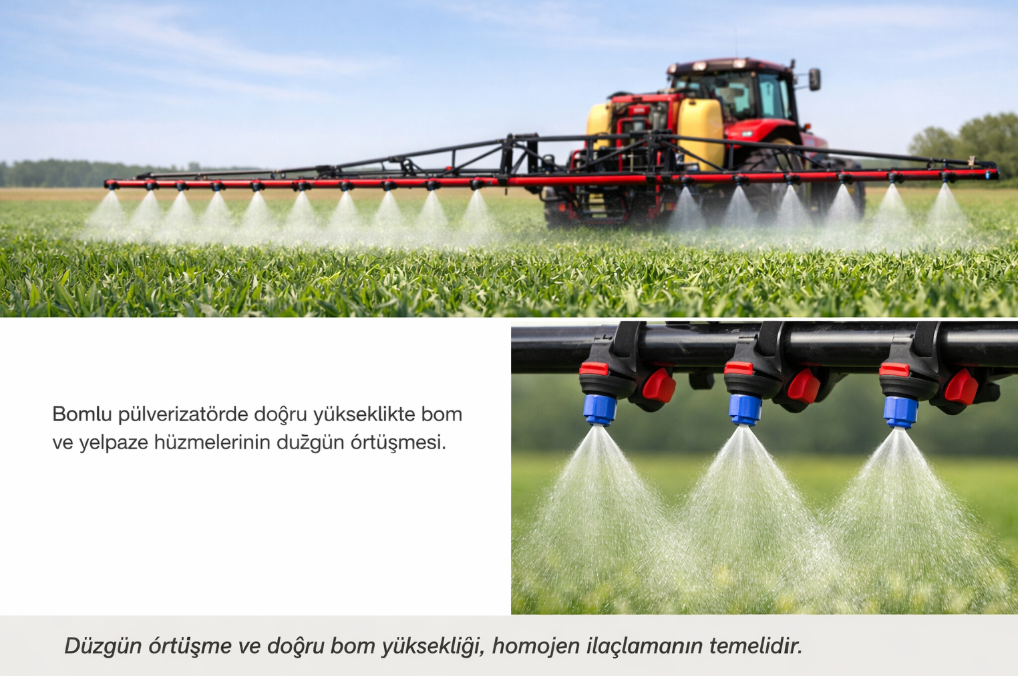
    Boom height and overlap

    • Keep boom height appropriate for the target; unnecessary height increases drift.
    • Flat-fan overlap must be uniform; striping indicates calibration/height errors.

    Maintain constant speed

    • Spray at the same speed used during calibration. Throttle/gear fluctuations distort the application rate.

    Pressure management

    • Higher pressure produces finer droplets; coverage may increase, but drift risk increases. Keep pressure within the nozzle’s recommended range.

    Mixing order (general principle)

    • Half-fill the tank with water → start agitation → add products in the label-recommended order → top up with water.
    • Pouring powders/granules directly without proper pre-mixing increases lumping and filter-clogging risk. (Follow the label mixing instructions.)

    C) After spraying

    Triple rinse and circulation

    • Empty the tank, refill with clean water, circulate through lines and nozzles, and rinse; repeat several times.
    • Do not leave water in the lines; especially important in frost-prone areas.

    Special cleaning after herbicides

    • After herbicide applications, perform tank/line cleaning per label and technical guidance to reduce phytotoxicity risk in the next spray (field methods like ammonia/activated carbon exist, but product and manufacturer instructions take priority).
    • Apply protective maintenance to metal parts to reduce corrosion risk after cleaning.

    Replace worn parts

    • At season end, inspect and replace nozzles, filter elements, hoses, and seals as needed.

    Common mistakes and correct practice notes

    • Spraying without calibration: the most common cause of yield loss and drift.
    • Mixing nozzles: application rate varies along the boom; “striped” results appear.
    • Continuing with worn nozzles: flow increases; turns into hidden over-application.
    • Dirty water and weak filtration: clogging → uneven distribution → failed control.
    • High boom + fine droplets + wind: drift, damage to neighboring crops, environmental risk.
    • Neglecting PPE: operator health risks—short-term irritation and serious long-term exposure.

    Maintenance, monitoring, and control

    • Start of season: pump performance, regulator, pressure gauge accuracy, filter set, nozzle set replacement.
    • Pre-application routine: leak check, filter cleaning, nozzle visual check, quick flow check.
    • Post-application: rinse + circulation, external cleaning, check moving parts.
    • Recordkeeping: date, product, target, application rate, nozzle type, pressure, speed, weather notes—necessary for traceability.

    Practical notes for Türkiye

    • Water quality: hard/silty water increases filter clogging and may reduce efficacy for some products. Prefer clean source water or well-filtered water when possible.
    • Wind regime: in Marmara and Central Anatolia, winds often increase during the day; early morning may be more manageable for drift.
    • Sloped terrain: maintaining constant speed becomes difficult; application rate fluctuates. Lower speed and tighter boom-height control are needed.
    • Near settlements/bees/greenhouses: drift-sensitive areas require drift-reducing nozzles, buffer zones, and careful weather selection.
    • Regulations and records: recordkeeping for prescription products and inspections also improves application quality.

    FAQ

    How often should calibration be done?
    At the start of the season, when changing nozzles, when pressure/speed routines change, and as a quick check at the start of each spraying period.

    A nozzle is clogged—can I open it with wire?
    No. Wire/nails enlarge the orifice and distort flow. Use compressed air or a soft brush; replace the nozzle if necessary.

    Are fine or coarse droplets better?
    It depends on the target. Fine droplets can be effective where coverage is critical, but drift risk increases. In drift-sensitive areas, coarse droplets and drift-reducing nozzles are safer.

    Does increasing pressure always increase efficacy?
    Not always. Higher pressure makes droplets finer and can increase drift and evaporation. Do not exceed the nozzle’s recommended pressure range.

    Why is it wrong to use different nozzles on the same boom?
    Each nozzle produces different flow and droplet spectrum; the application rate changes across the boom and the spray becomes non-uniform.

    Is it a problem if spray mix sits in the tank?
    Many products may settle, separate, or lose efficacy; corrosion and clogging risk also increases. Follow the label; generally, avoiding storage is best practice.

    If there is no wind, is drift risk zero?
    No. Under inversion conditions (especially evening/night), droplets can still move off-target.

    Why is cleaning after herbicides important?
    Herbicide residues can cause phytotoxicity on sensitive crops in the next application. Cleaning the tank, lines, and nozzles reduces this risk.

    Checklist

    • Product label and application instructions checked
    • PPE ready (gloves, goggles/mask, appropriate work clothing)
    • Tank water clean, filters intact
    • No leaks (hoses, clamps, fittings)
    • Pressure gauge and regulator functioning
    • Nozzles are the same type and in a set; no wear/clogging
    • Flow check completed; nozzle-to-nozzle variation acceptable
    • Calibrated application rate matches the target rate
    • Boom height correct, overlap uniform
    • Speed constant, pressure stable
    • Weather suitable (wind/drift risk manageable)
    • Triple rinse + line circulation completed after the job
    • Special post-herbicide cleaning applied (if needed)
    • Application records completed

    References / further reading

    • FAO — Pesticide application equipment and safe use (technical guides)
    • TAGEM — Technical publications on plant protection applications and equipment use
    • Republic of Türkiye Ministry of Agriculture and Forestry — Application principles, training, and regulatory documents for plant protection products
    • Faculties of Agriculture — Agricultural Machinery / Plant Protection course notes (sprayer calibration, nozzle selection)
    • ISO / EN standards — Standards on sprayer inspection and performance criteria (relevant series)