Short summary
Success in plant protection spraying with a sprayer depends on correct machine settings, choosing the right nozzle, maintaining the right driving speed, and performing regular calibration. Incorrect application reduces efficacy and increases drift-related environmental contamination, residue risk, and operator exposure. When maintenance and cleaning are neglected, nozzle clogging, uneven distribution, and equipment failures become inevitable.
Update Note (2026): This content has been technically verified and updated from the older text.
Basic definitions and concepts
Sprayer: A machine that applies pressurized liquid to the target as droplets through nozzles (e.g., field boom sprayer, orchard air-blast/turbo/atomizer sprayer, backpack sprayer).
Nozzle: The spraying component that determines droplet size, spray pattern, and flow rate.
Flow rate (Q): The volume of liquid discharged by one nozzle per unit time (L/min).
Application rate (spray volume): The amount of water applied per unit area (L/ha, L/da).
Droplet spectrum: The distribution of fine–medium–coarse droplets. Fine droplets improve coverage but increase drift risk; coarse droplets reduce drift but may reduce coverage.
Drift: The movement of droplets off-target due to wind.
Calibration: Measurement and adjustment procedures to ensure the sprayer applies the intended rate with uniform distribution.
Purpose and scope
Purpose: To increase efficacy by applying in accordance with the label-recommended rate and technique, while reducing off-target contamination, residue risk, and environmental risk.
Scope: Field crops (boom sprayers), orchards/vineyards/gardens (air-blast/turbo/atomizers), greenhouses and small areas (backpack/handheld sprayers).
Operating principle / mechanism
The pump pressurizes the mixture in the tank; the pressure regulator stabilizes pressure; filters retain solid particles; agitation keeps the product homogeneous; and the nozzles produce the spray pattern and droplet size. Application quality is determined by three main parameters:
- Flow rate (Q): Varies with nozzle wear and pressure.
- Speed (V): As speed increases, the liquid applied per unit area decreases.
- Working width / nozzle spacing (W): Boom height and nozzle spacing determine overlap.
Design and calculation logic
1) Basic formula for a field boom sprayer
Application rate per unit area:
Rate (L/ha) = (600 × Q) / (W × V)
Where:
- Q = flow rate of one nozzle (L/min)
- W = nozzle spacing (m)
- V = travel speed (km/h)
Note: All nozzles on the boom should be the same type and nominal flow rate. Mixing nozzles disrupts distribution.
2) Example calculation
- Nozzle spacing W = 0.50 m
- Travel speed V = 6 km/h
- Nozzle flow Q = 0.8 L/min (single nozzle)
Rate = (600 × 0.8) / (0.5 × 6) = 480 / 3 = 160 L/ha
With these settings, 160 L/ha is applied to the target. If the label-required rate differs, adjust nozzle flow (nozzle selection), pressure, or speed accordingly.
The pesticide amount is determined by the label; “dose per decare/hectare” values must follow the product label and official recommendations; for prescription-only products, guidance from an authorized agricultural engineer is essential.
Selecting the right nozzle (practical decision logic)
Nozzle selection should be evaluated together with the target (leaf/weed/soil), application type (contact/systemic), drift risk, and the intended application rate.
General suitability of nozzle types (summary)
| Nozzle type | Droplet tendency | Drift risk | Typical use note |
|---|---|---|---|
| Standard flat fan | Medium–fine | Medium | Field surface applications; good coverage, caution in wind |
| Drift-reducing / air-induction | Coarse | Low | Drift-sensitive areas; often preferred for systemic applications |
| Full cone | Medium | Medium | Some fungicide/insecticide applications where volume and penetration are needed |
| Hollow cone | Fine | High | Orchards/atomizers and applications needing intensive coverage; requires calm conditions |
Critical rule: Do not use different nozzle types/combinations on the same boom (distribution and droplet spectrum become inconsistent).
Application steps (field-practical)
A) Before spraying
Check the manual and the label
- Review the sprayer manual, filter–nozzle diagram, and recommended pressure ranges.
- Check the plant protection product label: target pest, timing, rate, mix compatibility, buffer zones, and PPE (personal protective equipment) requirements.
Clean water and filtration
- Fill with clean water. Dirty water is the fastest route to clogged nozzles/filters and uneven distribution.
- Check the triple filtration setup: tank strainer + line filter + nozzle filter.
Leak-tightness and mechanical checks
- Inspect hoses, clamps, and fittings for leaks and cracks.
- The pressure gauge and regulator must be functional.
Nozzle and strainer checks
- Remove and visually inspect nozzles; replace if worn, cracked, or deformed.
- Clear blockages with compressed air or a soft brush. Using wire/nails enlarges the orifice, increases flow, and disrupts the droplet spectrum.
- Never blow through a nozzle with your mouth (exposure risk).
Agitation (mixing) check
- If agitation fails, the mixture won’t stay homogeneous and “dose fluctuation” occurs within the same tank.
Tank level indicator and capacity
- Know the true tank volume and the accuracy of the level indicator. Level errors become dose errors.
Calibration pre-check
- Measure each nozzle’s flow at the selected nozzle and pressure (collect for 1 minute).
- If nozzle-to-nozzle variation exceeds 10%, replace the relevant nozzle set.
B) During spraying
Manage weather conditions
- Wind increases drift. Drift can also occur in very calm evening/night conditions with temperature inversion (e.g., foggy or smoky air that “hangs” near the ground).
- In hot, dry, windy conditions, fine droplets are especially risky; choose drift-reducing nozzles and coarser droplets.
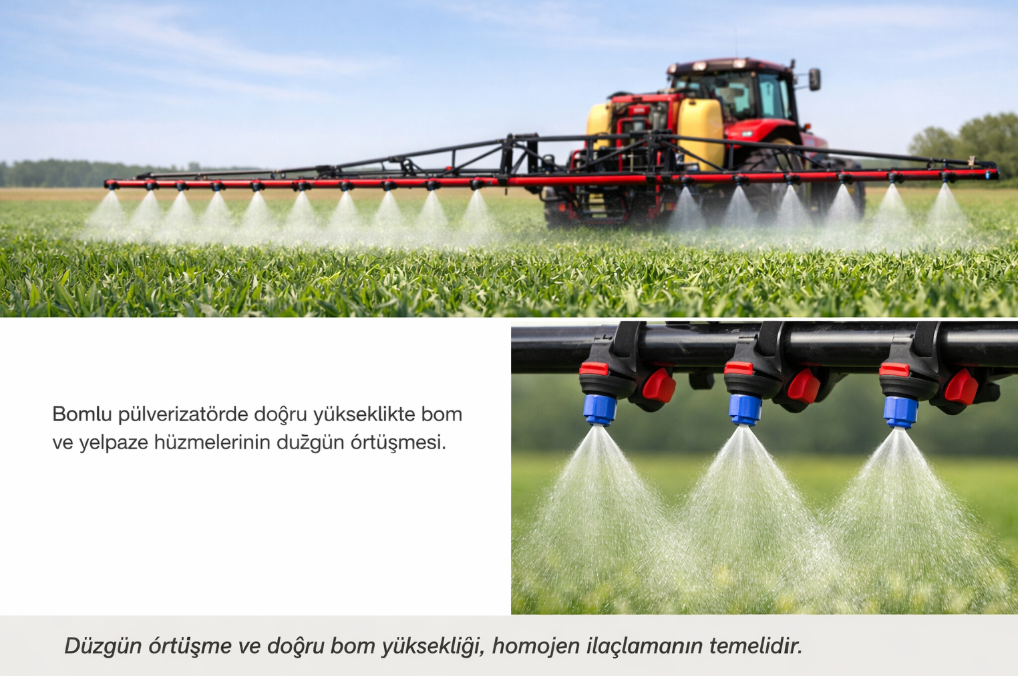
Boom height and overlap
- Keep boom height appropriate for the target; unnecessary height increases drift.
- Flat-fan overlap must be uniform; striping indicates calibration/height errors.
Maintain constant speed
- Spray at the same speed used during calibration. Throttle/gear fluctuations distort the application rate.
Pressure management
- Higher pressure produces finer droplets; coverage may increase, but drift risk increases. Keep pressure within the nozzle’s recommended range.
Mixing order (general principle)
- Half-fill the tank with water → start agitation → add products in the label-recommended order → top up with water.
- Pouring powders/granules directly without proper pre-mixing increases lumping and filter-clogging risk. (Follow the label mixing instructions.)
C) After spraying
Triple rinse and circulation
- Empty the tank, refill with clean water, circulate through lines and nozzles, and rinse; repeat several times.
- Do not leave water in the lines; especially important in frost-prone areas.
Special cleaning after herbicides
- After herbicide applications, perform tank/line cleaning per label and technical guidance to reduce phytotoxicity risk in the next spray (field methods like ammonia/activated carbon exist, but product and manufacturer instructions take priority).
- Apply protective maintenance to metal parts to reduce corrosion risk after cleaning.
Replace worn parts
- At season end, inspect and replace nozzles, filter elements, hoses, and seals as needed.
Common mistakes and correct practice notes
- Spraying without calibration: the most common cause of yield loss and drift.
- Mixing nozzles: application rate varies along the boom; “striped” results appear.
- Continuing with worn nozzles: flow increases; turns into hidden over-application.
- Dirty water and weak filtration: clogging → uneven distribution → failed control.
- High boom + fine droplets + wind: drift, damage to neighboring crops, environmental risk.
- Neglecting PPE: operator health risks—short-term irritation and serious long-term exposure.
Maintenance, monitoring, and control
- Start of season: pump performance, regulator, pressure gauge accuracy, filter set, nozzle set replacement.
- Pre-application routine: leak check, filter cleaning, nozzle visual check, quick flow check.
- Post-application: rinse + circulation, external cleaning, check moving parts.
- Recordkeeping: date, product, target, application rate, nozzle type, pressure, speed, weather notes—necessary for traceability.
Practical notes for Türkiye
- Water quality: hard/silty water increases filter clogging and may reduce efficacy for some products. Prefer clean source water or well-filtered water when possible.
- Wind regime: in Marmara and Central Anatolia, winds often increase during the day; early morning may be more manageable for drift.
- Sloped terrain: maintaining constant speed becomes difficult; application rate fluctuates. Lower speed and tighter boom-height control are needed.
- Near settlements/bees/greenhouses: drift-sensitive areas require drift-reducing nozzles, buffer zones, and careful weather selection.
- Regulations and records: recordkeeping for prescription products and inspections also improves application quality.
FAQ
How often should calibration be done?
At the start of the season, when changing nozzles, when pressure/speed routines change, and as a quick check at the start of each spraying period.
A nozzle is clogged—can I open it with wire?
No. Wire/nails enlarge the orifice and distort flow. Use compressed air or a soft brush; replace the nozzle if necessary.
Are fine or coarse droplets better?
It depends on the target. Fine droplets can be effective where coverage is critical, but drift risk increases. In drift-sensitive areas, coarse droplets and drift-reducing nozzles are safer.
Does increasing pressure always increase efficacy?
Not always. Higher pressure makes droplets finer and can increase drift and evaporation. Do not exceed the nozzle’s recommended pressure range.
Why is it wrong to use different nozzles on the same boom?
Each nozzle produces different flow and droplet spectrum; the application rate changes across the boom and the spray becomes non-uniform.
Is it a problem if spray mix sits in the tank?
Many products may settle, separate, or lose efficacy; corrosion and clogging risk also increases. Follow the label; generally, avoiding storage is best practice.
If there is no wind, is drift risk zero?
No. Under inversion conditions (especially evening/night), droplets can still move off-target.
Why is cleaning after herbicides important?
Herbicide residues can cause phytotoxicity on sensitive crops in the next application. Cleaning the tank, lines, and nozzles reduces this risk.
Checklist
- Product label and application instructions checked
- PPE ready (gloves, goggles/mask, appropriate work clothing)
- Tank water clean, filters intact
- No leaks (hoses, clamps, fittings)
- Pressure gauge and regulator functioning
- Nozzles are the same type and in a set; no wear/clogging
- Flow check completed; nozzle-to-nozzle variation acceptable
- Calibrated application rate matches the target rate
- Boom height correct, overlap uniform
- Speed constant, pressure stable
- Weather suitable (wind/drift risk manageable)
- Triple rinse + line circulation completed after the job
- Special post-herbicide cleaning applied (if needed)
- Application records completed
References / further reading
- FAO — Pesticide application equipment and safe use (technical guides)
- TAGEM — Technical publications on plant protection applications and equipment use
- Republic of Türkiye Ministry of Agriculture and Forestry — Application principles, training, and regulatory documents for plant protection products
- Faculties of Agriculture — Agricultural Machinery / Plant Protection course notes (sprayer calibration, nozzle selection)
- ISO / EN standards — Standards on sprayer inspection and performance criteria (relevant series)
Leave a Reply