Short summary
“Dollar spot” is a common turfgrass leaf disease that kills leaf tissue and creates small, round, straw-colored spots. As outbreaks intensify, spots coalesce and turf quality can decline quickly. Roots and crown tissue are usually not the primary target; the main loss comes from reduced leaf area, weakening of the turf, and a drop in visual/playing quality. In most cases, disease severity can be managed effectively through fertility (especially nitrogen), leaf-wetness duration, and sound maintenance practices.
Update Note (2026): This content has been technically verified and updated from an older text.
Key definitions and concepts
Pathogen: Dollar spot is now linked to species in the genus Clarireedia; older sources often use the name Sclerotinia homoeocarpa.
Susceptible turfgrasses: Common on cool-season species, especially Agrostis stolonifera (creeping bentgrass), Poa annua (annual bluegrass), Lolium perenne (perennial ryegrass), and Festuca spp. The term “annual Poa” in many facilities refers to Poa annua; Poa pratensis (Kentucky bluegrass) is a different species.
Leaf wetness: Extended periods of moisture on the leaf surface due to dew, fog, late/incorrect irrigation timing, or poor air movement.
Thatch: A layer of living/dead stems and organic debris; it can create a favorable microclimate and survival niche for the pathogen.
Resistance management: Repeated use of fungicides with the same mode of action can reduce sensitivity; resistance to certain groups has been reported in dollar spot.
Purpose and use cases
- Maintain quality in golf greens, tees, and fairways; sports fields; professional landscapes; and residential lawns.
- Reduce disease pressure, prevent spot coalescence (patch formation), and accelerate recovery.
- Make chemical control a targeted tool supported by cultural practices, and reduce resistance risk.
How it works (disease cycle / mechanism)
Survival: The pathogen mainly persists as mycelium in thatch and infected plant debris; it becomes active again as temperatures rise in spring.
Infection window: Prolonged dew and high humidity are critical. Field experience often shows risk increases notably with 8+ hours of leaf wetness. Mild to warm conditions (roughly 13–29 °C) favor disease development.
Spread: Spore production is not usually the practical driver. Spread is mostly via movement of infected leaf fragments through mowing, raking, aeration, equipment, and footwear.
Symptoms and distinguishing features
On closely mown turf (greens/fairways):
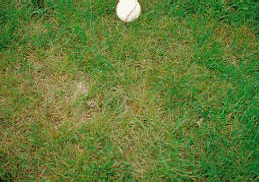
Small, round to oval, straw-colored spots 2–6 cm in diameter. Many foci can develop and merge.
On higher-cut turf (parks/residential lawns):
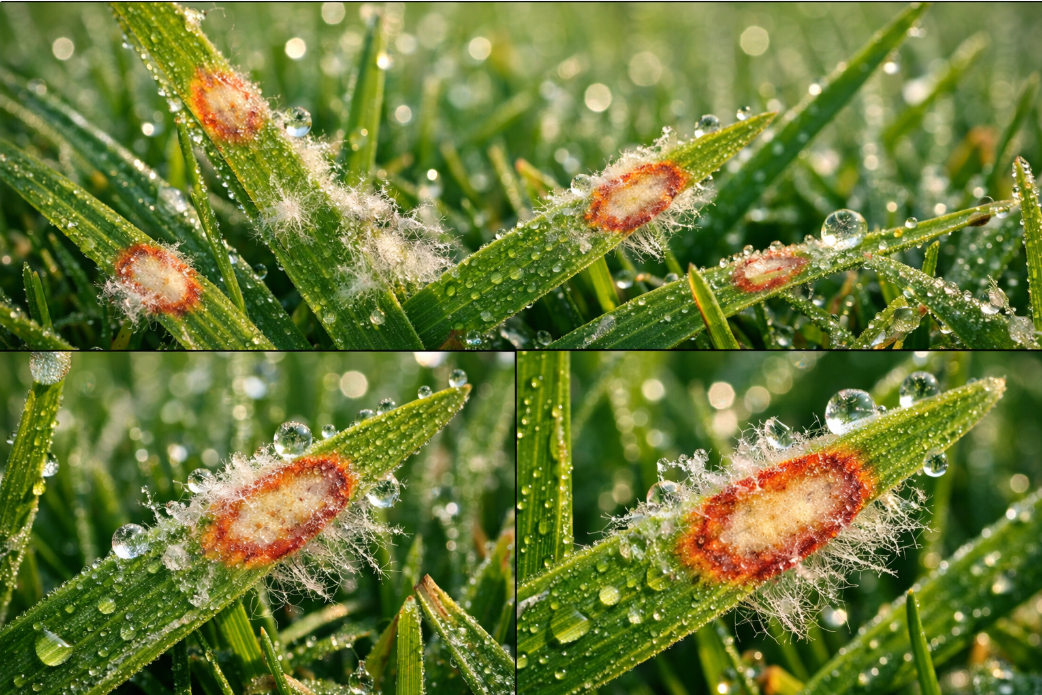
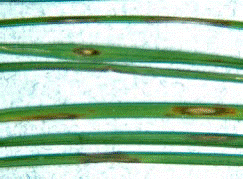
Elongated leaf lesions are often easier to see: straw-colored centers with reddish-brown margins.
Early-morning clue:
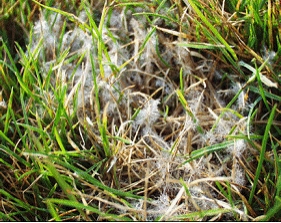
After long dew periods, you may see cottony/spider-web-like white mycelial strands in affected areas. They disappear quickly with sunlight and air movement.
Common look-alikes:
Nutrient deficiency (especially nitrogen), drought stress, mowing injury, and some leaf blights can mimic dollar spot. Use the combination of morning mycelium + typical spot/lesion form + circular spread patterns to improve diagnosis.
Planning logic and calculation
1) Fertility target: “Avoid deficiency, avoid excess”
Dollar spot often intensifies on nitrogen-starved turf. Adequate nitrogen helps the plant recover faster. However, excessive nitrogen can increase susceptibility to other diseases and create soft tissue risk. Annual nitrogen needs in cool-season golf turf vary widely by species, sand content, traffic, and the maintenance program. As a general starting range frequently cited for creeping bentgrass putting greens: 1–2 lb N per 1000 ft² per year (≈ 5–10 g N/m²/year).
2) Example calculation: From target N to fertilizer amount
Goal: Apply 0.5 g N/m² in a single application over 300 m² during the growing season.
- Total actual N needed:
300 m² × 0.5 g/m² = 150 g N - Fertilizer label: assume a product with 20% N (e.g., “20-0-0”)
- Required fertilizer product:
150 g ÷ 0.20 = 750 g product
Application intervals and annual totals should be adjusted based on use intensity, soil/thatch conditions, and turf species. The safest approach is to calibrate the program using soil testing + turf observation + clipping yield tracking.
Practical action steps
Confirm diagnosis:
Early-morning scouting (mycelium present/absent), spot diameter and circular spread, lesion form on leaves, site history (nitrogen program, irrigation timing, mowing height).
Shorten leaf wetness duration:
Shift irrigation to pre-dawn/near sunrise; avoid evening/night irrigation; if needed, disperse dew (brush/drag mat) and improve air circulation.
Correct the nitrogen program:
If deficiency signs exist, use a small-dose / more-frequent approach to help turf recover—without overloading.
Mowing and equipment hygiene:
Sharp blades, correct height, clean equipment after mowing infected areas; manage clippings according to site policy (collect/return) when pressure is high.
Thatch and compaction management:
Use appropriately timed aeration (core/solid tine), topdressing, and verticutting to improve the microclimate. Avoid overly aggressive operations that add stress; plan by season and weather.
Chemical control if needed:
Use only registered products for turf and the specific site type; follow label rate, compatibility, interval, and rotate modes of action—do not rely on a single group repeatedly.
Common mistakes and what to do instead
- Mistake: Extending dew through evening irrigation
Do instead: Move irrigation to early morning so foliage dries quickly during the day. - Mistake: “The turf is weak—stop fertilizing entirely”
Do instead: Correct nitrogen deficiency in a measured way to speed recovery. - Mistake: Ignoring thatch
Do instead: Reduce thatch/compaction gradually; avoid sudden, high-stress interventions. - Mistake: Treating fungicide as the only solution
Do instead: Combine cultural practices + resistance management + targeted applications. - Mistake: Repeating the same mode of action continuously
Do instead: Use rotation and/or mixed programs; limit solo, repeated use in higher-risk groups.
Maintenance, monitoring, and control
Scouting frequency:
During risk periods (late spring–early summer and fall; long-dew periods), conduct at least two site walks per week.
Record keeping:
Irrigation timing, fertilization dates, mowing height, weather (night humidity/dew), and cultural operations.
Mapping:
Sketch and track hotspots. Recurrent spots in the same area often indicate fertility/thatch/compaction problems.
Quality indicators:
Spot counts and coalescence tendency, turf color, clipping volume, recovery speed.
Chemical control: principles and resistance management
Different fungicide mode-of-action groups are used against dollar spot, but availability and registration depend on country and use setting. Some active ingredients have been restricted or removed in many places; for example, chlorothalonil approval was not renewed in the EU.
Core rules:
- Use only products registered for turf and the specific use area; follow label and local regulations.
- Rotate: avoid back-to-back use of the same FRAC (mode-of-action) code; prefer programs with multiple modes of action where appropriate.
- Resistance risk: Dollar spot resistance is well documented for certain groups, notably MBC fungicides (e.g., thiophanate-methyl); repeated solo use is risky.
- Pair with cultural control: Shorter leaf wetness + thatch management + adequate nutrition often improves fungicide performance significantly.
Note: Pesticide selection and application should be done by authorized professionals. Rate, interval, tank mix, and re-entry/closure details must follow the product label and official guidance.
Practical notes for Türkiye
Coastal regions (Marmara–Aegean–Mediterranean):
When night humidity and dew duration increase, dollar spot pressure rises. Edge/vegetation management that improves airflow, early-morning irrigation, and dew dispersal become critical.
Interior regions:
Hot days + cool nights can extend wetness if irrigation is heavy or mistimed. Avoid “light and frequent” surface watering; irrigate to a root-appropriate depth at the correct time.
Saline/hard irrigation water:
Salt stress and leaf burn can weaken turf and indirectly increase disease. Water analysis and (where drainage allows) leaching plans become important.
Thatch buildup:
Frequent irrigation + low mowing height + insufficient aeration can make pressure chronic. The backbone of the cultural program should be thatch/compaction management.
FAQ
- Does dollar spot kill the roots?
Typically, the main damage is in the leaves; roots and crown are not the direct target. Long-term stress can indirectly reduce rooting. - Why is it more visible in the morning?
Mycelium is easier to see under dew/high humidity conditions early in the day; it disappears with sun and airflow. - What are the strongest triggers?
Long leaf-wetness duration (dew/irrigation) plus nitrogen deficiency is the most common high-impact pair. - Does mowing height matter?
Yes. Very low mowing adds stress and can shift the microclimate in favor of the disease. If site standards allow, raising height can speed recovery. - Will nitrogen alone eliminate it?
Correcting deficiency often reduces pressure sharply, but it is not a standalone cure. Leaf wetness and thatch management must be addressed too. - Why is repeated use of the same fungicide risky?
Same mode of action can accelerate resistance selection; rotations are essential. - What should be done with clippings from infected areas?
When pressure is high, clean equipment and manage clippings per the site plan to avoid moving infected tissue to new areas. - When is it most common?
In cool-season turf: typically late spring–early summer and fall, especially during long-dew periods.
Checklist
- Early-morning scouting for mycelium and spotting
- Shift irrigation timing to early morning
- Remove nitrogen deficiency risk (small dose, more frequent)
- Sharp mower blades and correct mowing height
- Scheduled aeration + topdressing for thatch/compaction
- Reduce spread via equipment/footwear cleaning after infected areas
- Chemical control: registration/label compliance + mode-of-action rotation
- Keep consistent records (weather–irrigation–fertility–operations)
References / Further reading
- University of Delaware Cooperative Extension — Dollar Spot of Turfgrass
- USGA Green Section Record — General nitrogen ranges for creeping bentgrass greens
- UC IPM (University of California) — Turfgrass Dollar Spot: cultural control principles
- Hu et al., 2018 — Thiophanate-methyl (MBC) resistance and genetic basis (PubMed)
- EU regulations — chlorothalonil non-renewal decisions (EUR-Lex)
Leave a Reply