Short Summary
The rose sawfly (Arge rosae) is a pest whose larvae can quickly skeletonize rose leaves and, under heavy infestation, cause clear leaf loss (defoliation). If the population is detected early, hand-picking and regular monitoring are sufficient in most gardens. The most common mistake is assuming the larvae are “caterpillars” and applying controls aimed at the wrong target.
Video link related to the presentation by Agricultural Engineer Süreyya ALTUNIŞIK: https://www.facebook.com/reel/805043102591192
Basic definitions and concepts
Rose sawfly (Arge rosae): A species in the order Hymenoptera, family Argidae. Damage occurs not in the adult stage, but in the larval stage.
Sawfly larva vs. caterpillar (key diagnostic point)
Sawfly larvae typically have more abdominal prolegs (in most cases 6–8 pairs). Butterfly/moth caterpillars generally have no more than 5 pairs of prolegs. This distinction matters in practice, because some biological/selective approaches are designed for Lepidoptera caterpillars and may not work on sawfly larvae.
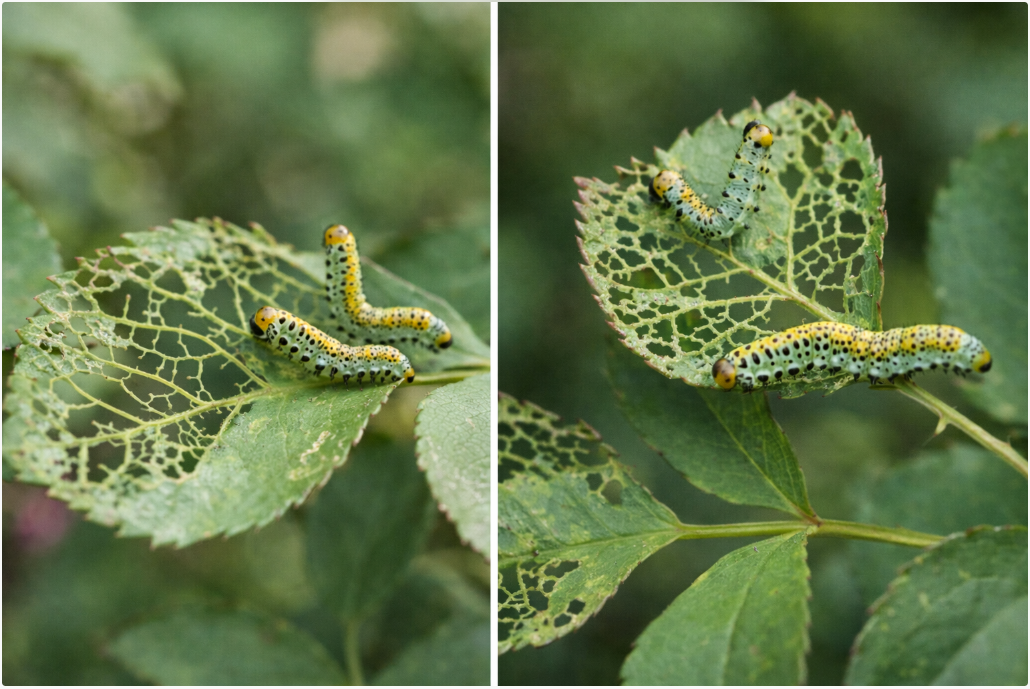
Appearance of damage
Because the veins can remain intact for a while as the leaf tissue is eaten, skeletonization is typical. When infestation intensifies, most leaves on affected shoots can be lost and the plant weakens rapidly.
Purpose and scope of application
Purpose: Limit leaf loss and shoot weakening; preserve flowering performance; suppress the population before it builds up.
Scope: Roses in home gardens, parks and residential landscapes, ornamental rose plantings (in general, all roses are at risk).
Working principle / mechanism
Life cycle (field-observed sequence)
Adults lay eggs in leaf tissue at the appropriate time. Larvae hatch and feed on leaves, often clustered on the same leaf and shoot. Mature larvae drop to the soil; the cocoon/pupal stage occurs in the soil. If climatic conditions are favorable, more than one generation may occur within a season.
Conditions that accelerate damage
Warm, calm weather; young, succulent leaf tissue; stressed plants (especially irregular watering and nutrient imbalance); and lack of monitoring can allow the population to surge quickly.
Design and calculation logic
Monitoring (sampling) plan
Select at least 10 rose plants that represent the area. On each plant, check 5 shoots from different directions.
Total checks: 10 × 5 = 50 shoots
Record 1 — Infestation rate (%)
(Number of shoots where larvae are observed / total shoots) × 100
Record 2 — Leaf-loss severity (0–3)
0: No damage
1: Light (small “windowing,” limited skeletonization)
2: Moderate (a clear portion of the leaf surface eaten)
3: Severe (most leaves on the shoot lost)
Example calculation
If larvae are observed on 12 out of 50 shoots:
Infestation = 12 / 50 × 100 = 24%
Severity distribution: 6 shoots (1), 4 shoots (2), 2 shoots (3)
This indicates the population has entered a “moderate–high” band. If severity classes 2–3 are increasing, do not delay mechanical removal and cultural measures; if class 3 becomes dominant, increase the intensity of intervention.
Application steps
1) Correct diagnosis
Larvae often appear with a greenish body, black spots, and yellowish stripes. When disturbed, they commonly curl into an “S”-like posture. The damage pattern is less about neat holes and more about surface scraping and skeletonization.
2) Mechanical control (first choice)
In cool hours, larvae are less active; hand-picking and pruning/removing infested leaves/shoots and disposing of them in a sealed bag is effective. Clustered larvae can be knocked off with a water jet; however, if fallen larvae are not managed, they may climb back up.
3) Cultural measures
Reduce excessive weeds at the base and thick accumulations of organic debris; this limits sheltered microhabitats during the soil stage. Reduce watering stress; avoid excessive nitrogen feeding that triggers “soft shoot flushes.” Maintain balanced pruning that preserves canopy airflow.
4) Protecting biological balance
Avoid unnecessary broad-spectrum treatments, as they can suppress beneficial organisms too. Maintain diversity that supports natural enemies such as birds, spiders, and predatory insects.
5) Chemical control (if needed)
Consider it for heavy and recurring infestations when mechanical and cultural measures are insufficient. Use only registered plant protection products according to the label, and, where required, under the guidance/prescription of an authorized agricultural engineer. Two practical factors determine success: correct timing (active feeding period) and adequate coverage (both upper and lower leaf surfaces).
Common mistakes and correct-practice notes
- Assuming larvae are caterpillars: Choosing the wrong target makes treatments ineffective. Do not ignore proleg count and the damage pattern.
- Confusing damage with disease: Skeletonization usually indicates feeding damage, but it can be confused with leaf-spot diseases.
- Leaving infested material on site: If cut shoots/leaves remain in the area, spread can continue.
- Relying on a single check: Populations can rebound quickly; re-check within 3–7 days after intervention (depending on weather).
Maintenance, monitoring, and control
During risky periods, weekly checks are the baseline approach. If density is observed, shorten the interval to every 3–4 days. Keep records each time using the same sampling method. If severity class 2–3 shoots are decreasing, the method is working; if they increase, revise the intervention level.
Practical notes for Türkiye conditions
First appearance may start earlier in coastal zones; in inland regions, start dates shift later due to delayed warming. Where irrigation regimes are poor, the impact of leaf loss on the plant is harsher. In parks and residential landscapes, block plantings with a single species/variety increase risk; monitoring should be more frequent. A thick mulch layer can provide shelter during the larva-to-soil descent and cocoon stage; rather than removing it completely, controlled thinning and base cleanup is a balanced approach.
FAQ
- Are the larvae caterpillars?
No. They are sawfly larvae; therefore, some caterpillar-targeted solutions may not work. - Leaves are full of holes—fungus?
Skeletonization and surface feeding suggest insect damage. Searching for larvae on the leaf speeds diagnosis. - What is the fastest solution?
Early hand-picking and removal of infested shoots is sufficient in most gardens. - Will the plant die?
One-time moderate damage is not usually fatal for most roses. Repeated severe defoliation, however, weakens the plant and significantly reduces flowering. - When should I control/monitor?
Increase monitoring during periods of strong shoot growth; shorten the interval as soon as the first larvae are seen. - Do larvae knocked off with water climb back?
Some can. Fallen larvae must also be managed. - Does pruning help?
Selective pruning of infested shoots quickly reduces the population, especially in clustered infestations. - Is chemical control mandatory?
No. Monitoring + mechanical + cultural measures usually provide control. Consider chemicals only for severe and recurring cases.
Checklist
- Sawfly larva vs. caterpillar identification done (proleg count, behavior, damage type)
- Infestation recorded using the 10 roses × 5 shoots sampling method
- Infested shoots/leaves collected and removed from the area in a sealed manner
- Base cleanup and excessive weeds/organic debris accumulation managed
- Watering stress and excessive nitrogen-feeding risk checked
- Re-check planned within 3–7 days
- If needed, note: only registered products + label compliance + authorized expert framework
References / Further Reading
- EPPO — Rose pests and integrated control notes
- CABI — Arge rosae and rose pest datasheets
- Royal Horticultural Society (RHS) — Roses: sawfly larvae identification and management
- FAO — Core principles of Integrated Pest Management (IPM)
- TAGEM / Provincial Directorates of Agriculture and Forestry — Field briefings on ornamental plant pests
- University Faculty of Agriculture entomology notes — Hymenoptera pests, identification keys
Leave a Reply